

Many companies sell AI products to big enterprises. The demo works well and the pilot also looks good. But when the AI goes into the customer’s real environment, things get stuck. It gives wrong answers on the customer’s own data. It cannot reach the systems where the work happens. The security team will not allow data to go outside. The problem is not the AI model. The problem is that nobody has done the work to make the AI fit this customer properly.
This is the job of a forward deployed engineer (FDE). An FDE goes to the customer, works inside their environment, and makes the AI actually work there. It is a fast growing engineering role in 2025 and 2026, but many people are still not clear what it means. In this blog, let’s see why AI companies need FDEs, what an FDE does, what skills are needed, and the skills behind the role, which are useful for every engineer building with AI.
Where the role came from
The FDE role is older than today's AI. It started at Palantir, which was using this title around 2009 to 2010, depending on the source. The term "forward deployed" comes from the military. Palantir's early customers were intelligence and defence agencies, and to solve their problems, Palantir had to send its engineers to work inside the customer's place.
Palantir explains the difference in a simple way:
A product engineer works on one capability, for many customers.
A forward deployed engineer works for one customer, across many capabilities.
Why AI companies need FDEs now
Some companies, like Ramp (spend management) and Commure (healthcare), use FDEs for products that are not AI. But enterprise AI adoption is a major reason the role is growing so fast now.
The reason is simple. An AI model on its own knows nothing about a customer’s business. It becomes useful only when it has the customer’s context and access to their systems. AI agents “require active management, guided learning, and rich context that comes from read/write access to internal systems”. So someone has to connect the AI to the customer’s data and tools, decide what it is allowed to do, and prove that it works on the customer’s real cases. That someone is the FDE.
This work is costly, so the AI company makes less margin in the beginning. But once the AI becomes part of how the customer works, it is very hard for the customer to replace it. This actually is “trading margin for moat”. Please note this is an investor’s view, and the same essay expects that much of this work will move to partner companies once the products become mature.
AI companies have invested in this work: OpenAI's FDE team grew from two people to more than ten by August 2025.
What an FDE does
In simple terms, in an AI company, an FDE is a software engineer who works with one customer to make the AI give real, measurable results on that customer’s data, systems and workflows.
This is different from an AI engineer. An AI engineer usually builds AI features inside their own company’s product. An FDE builds them inside a customer’s environment, with the customer’s data, systems and people.
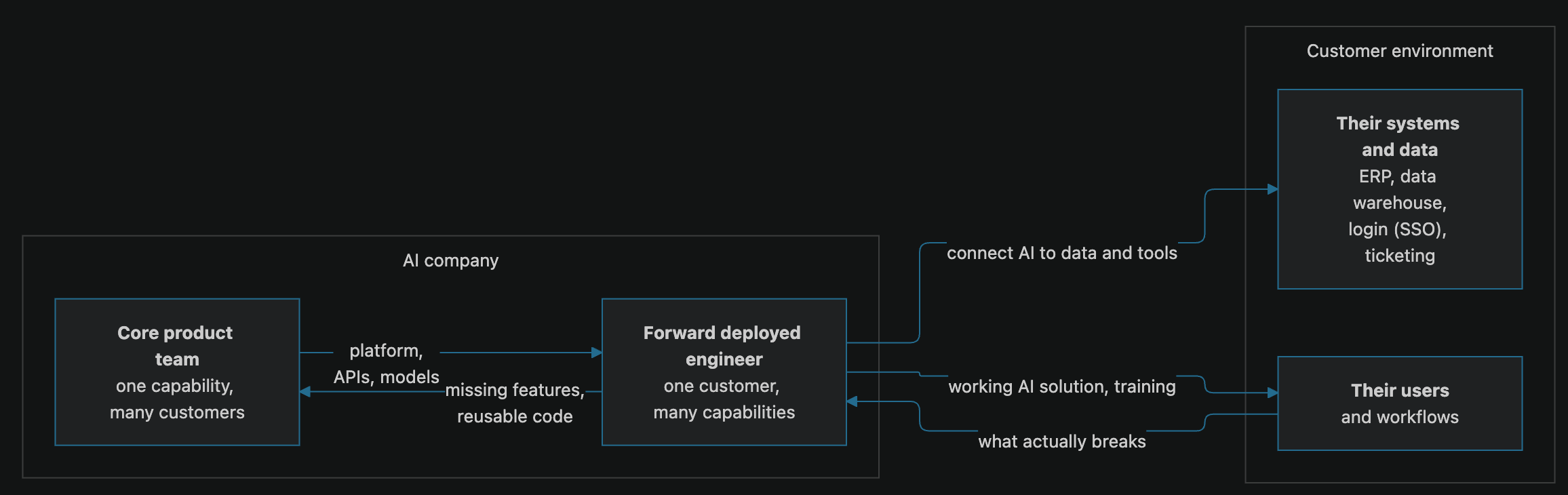
The arrow going back to the product team is as important as the arrows going to the customer. If an FDE solves the same problem for five customers and never tells the product team, then the company ends up with five things to maintain, not a better product. So for every piece of work, the FDE has to decide: can this be done with configuration, does it need custom code for this customer, or should it become a product feature? Getting this right is how custom work turns into a stronger product instead of technical debt.
How an FDE makes AI work for a customer
Pick the right use case : Find the real problem, check where the AI is reliable enough to trust, say no to the rest, and agree with the customer what "done" means, with numbers
Give the AI the customer's knowledge : Connect the AI to the customer's knowledge so that it answers from the customer's facts and not from general knowledge. Use retrieval (RAG) for documents, and direct database or API queries for structured data like orders or accounts
Give agents safe access : Connect AI agents to the customer's tools with the right permissions, and add human approval for risky actions like payments or deleting data
Prove it works : Build evals (test sets that check the AI's answers) from the customer's real cases. An AI model that does well on benchmarks can still fail on one customer's data
Put it into production : Integrate it with the customer's systems and security, train the users, and leave something the customer can run on their own
Keep it working : Keep checking quality, cost and speed, and run the evals again whenever the AI model changes
Feed the product : Take the work that repeats across customers and turn it into product features
Success is measured in business terms, not only correct answers: time saved per task, cost per task, and how often a human still has to step in.
Often, the customer knows their data and processes much better than the AI company. What they do not have is the experience of making AI work reliably in production. That is what the FDE brings.
How a typical engagement runs
OpenAI does FDE work in three phases: a short scoping phase at the customer's site, a validation phase using evals, and then delivery. If we add what happens after delivery, we get a flow that fits most FDE work:

Going back from validation to scoping is also part of the job. Sometimes validation shows that the AI cannot reach the target on this customer's data. A good FDE tells the customer early, instead of delivering something that works only in a demo.
A typical week
A typical week has customer time (workshops, interviews, demos), building time, and internal meetings with the product team. One Palantir FDE said they spend “a couple of days” a week at the customer’s site. Travel is a real part of the job: Palantir asks for up to 25% travel for FDSEs, and Commure says up to 50%. It varies a lot by company and customer.
Skills needed
The experience needed is different in each company. Palantir asks for a "strong coder" with a strong engineering background and one year of experience. Ramp prefers five or more years for senior FDEs. But the skills fall into the same four areas: software engineering, data and integration, AI application building, and working with customers.
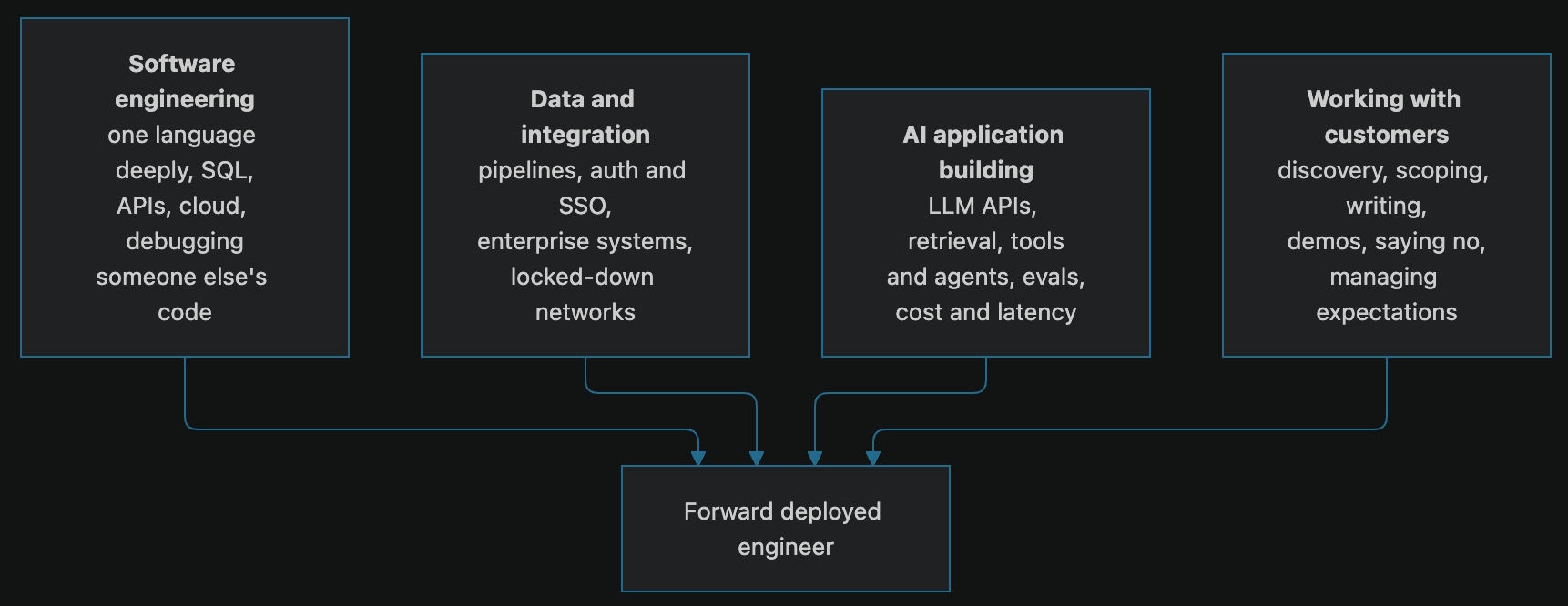
Knowing AI alone is not enough. To make AI work for a real customer, you need all four:
Software engineering is the base. You will often work alone on code you have not seen before. So you must be able to debug systems built by others and deliver reliable code without a team around you.
Data and integration is where most of the work is. Many AI projects get stuck not because of the model, but because of login and permissions, messy data, and processes that do not work the way they are documented. So you need to understand identity (OAuth, OIDC and SSO), private networks, audit logs, and data rules like where data is allowed to be stored.
AI application building means giving the AI the right context, connecting it to tools safely, and measuring how well it works. In practice this covers:
Agents and tools: tool calling, connecting agents to systems (for example with MCP, the Model Context Protocol), and human approval steps.
Evals: a set of real test cases, run again after every change, so that “the demo looked good” becomes a number the customer can trust.
Safety: guardrails against prompt injection and leaking private data.
Running in production: tracing, monitoring, cost and speed.
Working with customers is the skill engineers usually underestimate. You need to find the real problem behind what the customer asks, write clearly for senior leaders, and say no when AI is not the right answer. Palantir’s Deployment Strategist posting asks for people who “aren’t satisfied with surface-level answers” and have “low ego”.
Building these skills
You can build all four skills in your current job. Each stage below builds one skill area, in the same order. If you are already strong in one area, spend more time on the others.

Stage 1: Become an independent engineer. Learn to take a feature from an unclear request all the way to production on your own, and keep it running. Palantir hires FDSEs with just one year of experience, but expects them to own the “end-to-end execution”. You are ready when: you have built something that people depend on, and you were the one called when it broke.
Stage 2: Learn data and integration. Build a data pipeline that pulls from a real API. Learn OAuth and SSO properly. Learn one enterprise system in depth, like Salesforce, ServiceNow or SAP. Practise deploying in restricted environments with no internet access. You are ready when: you can connect two systems that were not designed to work together, and explain the security trade-offs.
Stage 3: Build AI applications and measure them. This is the stage that makes AI actually work in real systems. Build a retrieval system on top of messy documents, or an AI agent that takes actions using tools, with access control and human approval for risky actions. Then do the part most people skip: create an eval set, measure the results, and improve them. Track cost and speed also. You are ready when: you can say “it gets 87% of these 200 real cases right, this is why it fails, and this is the fix”.
Stage 4: Get real customer experience. This is what turns a good engineer into one who delivers real outcomes. Take up customer escalations or internal tools for operations teams. Talk to users and find the problem yourself. Build an AI tool for a small business or a non-profit, and support it for a few months. Practise writing one-page proposals. You are ready when: a non-technical person is still using something you scoped, built and handed over.
What the work is like
Pro: You see AI making a real difference for real users. Con: Travel, up to a quarter of your time or more
Pro: You work on many technologies. Con: A lot of context switching
Pro: You learn how businesses really work. Con: Pressure to deliver fast
Pro: Good experience for product, leadership. Con: A lot of ambiguity: “FDEs work in a ton of ambiguity”
In Summary:
An FDE is not just an engineer who deploys AI at a customer’s site. An FDE closes the gap between what AI can do and what the business actually needs, using software engineering, AI engineering, enterprise integration and customer problem-solving together.
A good AI model is not enough. AI gives real value only when someone connects it properly to the customer’s data, systems and way of working, and proves that it works there. That is why AI companies started investing in FDEs in 2025.
You don’t need the FDE title to build these skills. Every engineer building with AI needs them: be an independent engineer, get good at data and integration, learn to build and measure AI applications, and most importantly, practise solving problems for people who are not engineers.