

If you come from Java or C#, Go’s interfaces can feel… backwards.
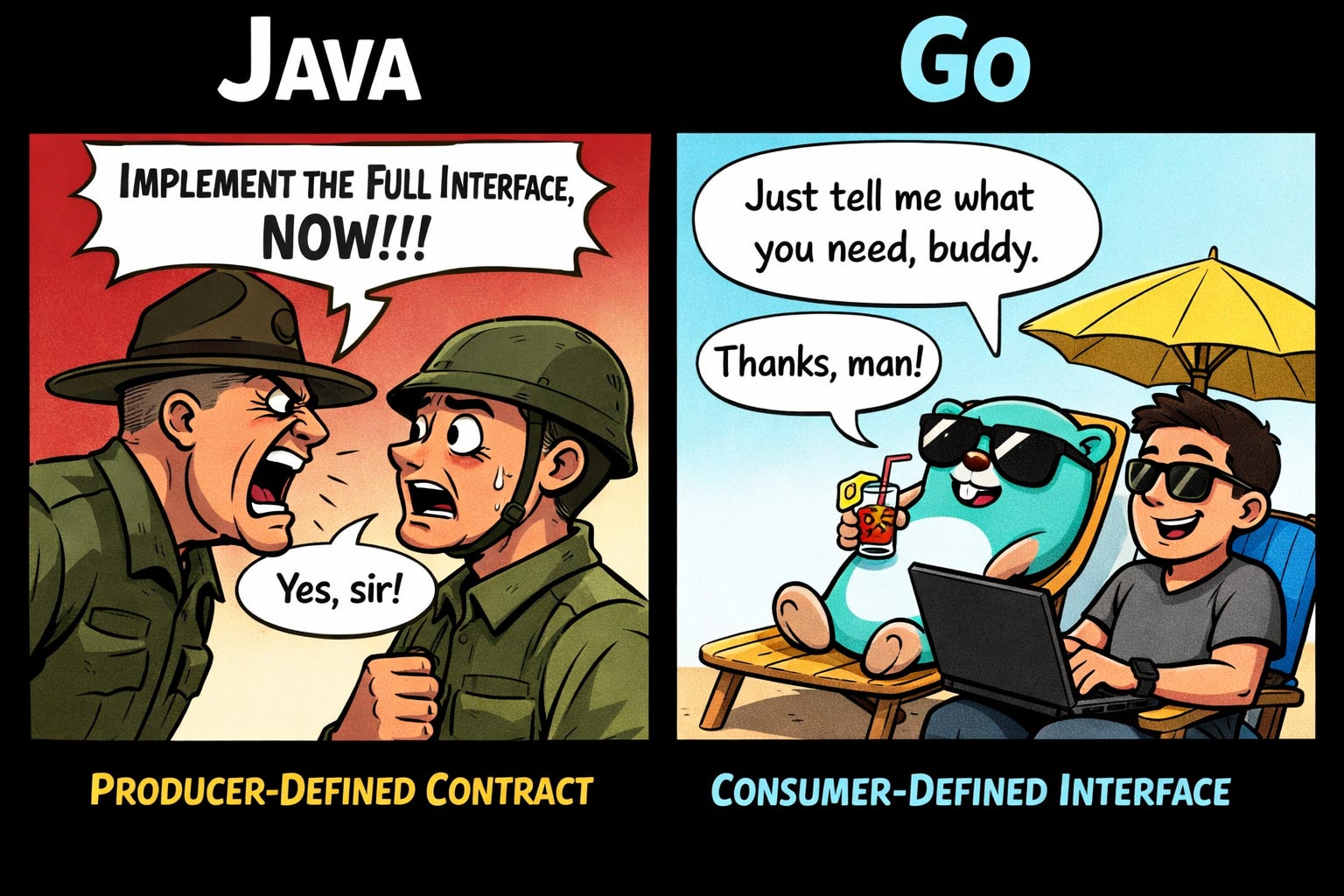
No implements.
No explicit contracts.
No giant interface files shared across teams.
Yet somehow, Go code ends up more decoupled, more testable, and easier to evolve.
This is not accidental.
Go follows a philosophy called consumer-defined interfaces — and once you understand it, you’ll never design APIs the same way again.
What “Consumer-Defined Interface” Means
In Go, the code that uses a dependency defines the interface — not the code that provides it.
This is the opposite of classical OOP.
Traditional OOP (Java / C#)
Producer defines the interface
Consumer must conform to it
Interface is a contract imposed from above
Go
Consumer defines exactly what it needs
Producer doesn’t even know the interface exists
Interface is a local expectation, not a global contract
The Classic Java / C# Model (Producer-Defined Contract)
Let’s start with what most of us learned first.
Java Example
// Producer defines the contract
public interface PaymentService {
    void charge(String userId, double amount);
    void refund(String transactionId);
    PaymentStatus getStatus(String transactionId);
}
Now every consumer must depend on everything, even if they only need one method.
public class OrderService {
    private final PaymentService paymentService;

    public OrderService(PaymentService paymentService) {
        this.paymentService = paymentService;
    }

    public void placeOrder() {
        paymentService.charge("u123", 100.0);
    }
}
Problems
Fat interfaces
Ripple effects when methods change
Mocking complexity
Interfaces become organizational artifacts, not design tools
Go’s Approach: Start With the Consumer
Now let’s do the same thing in Go — properly.
Consumer-Defined Interface in Go (The Right Way)
Step 1: Write the consumer first
type PaymentProcessor interface {
    Charge(userID string, amount float64) error
}
That’s it.
No refund
No status
Only what this consumer actually needs
Step 2: Use the interface
type OrderService struct {
    payments PaymentProcessor
}

func (s *OrderService) PlaceOrder(userID string, amount float64) error {
    return s.payments.Charge(userID, amount)
}
Step 3: Any type that matches implicitly works
type StripeClient struct{}

func (s *StripeClient) Charge(userID string, amount float64) error {
	// call Stripe API
     return nil
}
No implements.
No registration.
No inheritance.
It just works.
The Key Rule (Memorize This)
If a type has the methods, it satisfies the interface.
This is called structural typing.
Java/C# use nominal typing
Go uses structural typing
Why This Is So Powerful
Interfaces Stay Small (Automatically)
In Go, interfaces tend to look like this:
type Reader interface {
     Read(p []byte) (n int, err error)
}
Not this:
interface Reade
r {
    int read(byte[] b);
    int read(byte[] b, int off, int len);
    void close();
    boolean ready();
}
Because consumers define them, interfaces naturally become:
minimal
focused
easy to satisfy
No Up-Front Design Tax
In Java/C# you often hear:
“Let’s define interfaces first”
In Go, you hear:
“Let’s write real code first — interfaces will appear naturally”
You don’t design abstractions ahead of need.
Zero Coupling Between Packages
The producer does not import the consumer.
consumer → defines interface
producer → unaware it implements anything
This avoids:
dependency cycles
shared “contracts” packages
versioning nightmares
Testing Becomes Trivial
Go Test Example
type FakePayment struct{}

func (f *FakePayment) Charge(userID string, amount float64) error {
	return nil
}
Use it instantly:
func TestPlaceOrder(t *testing.T) {
	service := OrderService{
		payments: &FakePayment{},
	}

	err := service.PlaceOrder("u1", 50)
	if err != nil {
		t.Fatal(err)
	}
}
No mocking frameworks.
No annotations.
No magic.
When NOT to Use Interfaces in Go
Yes — interfaces can be overused.
Avoid interfaces when:
there is only one implementation
no testing or substitution is needed
the abstraction adds no clarity
Go proverb:
“Accept interfaces, return structs.”
Real-World Go Interfaces You Already Use
You’ve seen this pattern everywhere:
io.Reader
io.Writer
http.Handler
context.Context
None of these were designed as giant frameworks.
They are:
tiny
composable
consumer-driven
Bottomline - take away
Go’s consumer-defined interface principle is not just syntax — it’s a philosophy:
Design from usage, not speculation
Let behavior define contracts
Keep abstractions small and local
Decouple without ceremony
Once this clicks, Go stops feeling “minimal”
and starts feeling precise.
If you enjoyed this deep dive…
I write weekly about:
Go performance and runtime behavior
Kubernetes-native service design
Expert-level engineering lessons from real systems
Subscribe if you want more posts like this.